
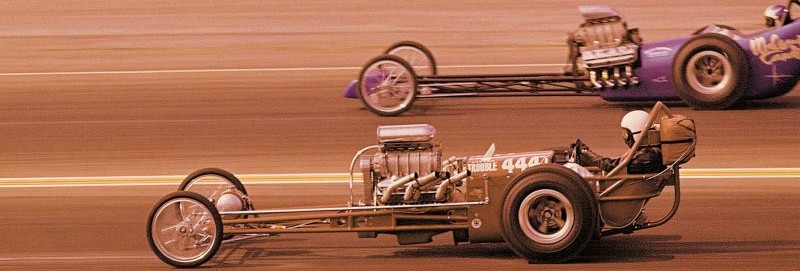
The professionalizing and corporatizing of Southland drag racing
The first breakthrough in the quest for a competitive edge came when it was determined that bald tires, which put more rubber in direct contact with the road, provided better traction than those still showing tread. To further exploit this discovery, builders began welding two wheels together in sets and mounting four bald tires on the rear axle, which improved traction so much it exposed another shortcoming. With more power being applied to the rear wheels and only one drive wheel in the conventional rear axle, the cars became even harder to hold on course and exhibited an alarming tendency to pivot on the free wheel and veer off into the bleachers.
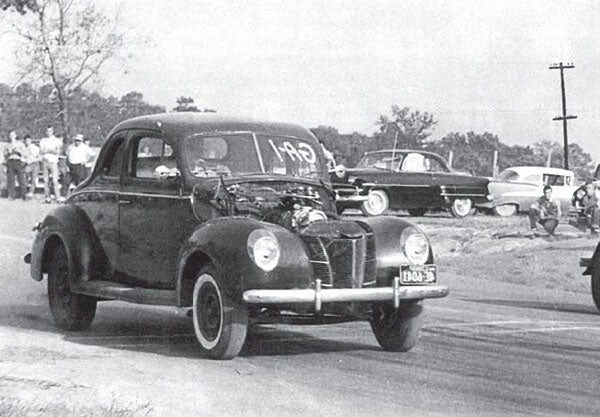
To minimize this dangerous inclination, drivers narrowed their rear axles and locked the rear end gears to better approximate a single drive wheel. Frames and front axles had to be narrowed as well to maintain balance. Stability was improved by lengthening the wheelbase. The result was a car with barely enough chassis to mount four wheels, an engine, and a driver.
Dubbed “rails” due to their elongated and exposed frame structure, they were the blank canvas on which builders continued to experiment with driver and the engine placement, types of engines, and number of engines.
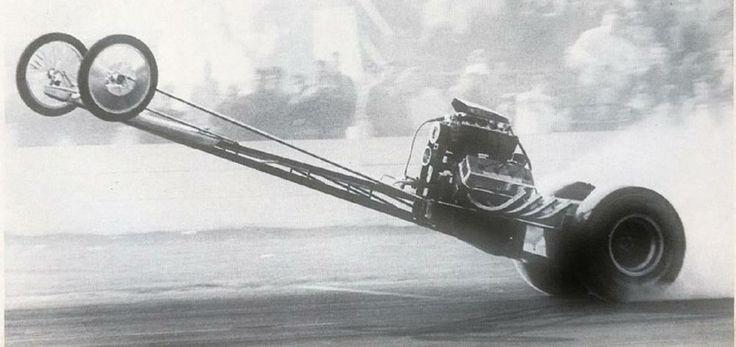
Some followed convention and placed the engine before the driver; others reversed that order. Some used huge airplane engines, but found the added power was usually offset by the added weight. Still others concocted bizarre, multi-engine cars in a variety of configurations: engine, engine, driver; or driver, engine, engine; or engine, driver, engine. Some sported engines two abreast, and at least one carried four engines, but these setups rarely performed well enough to justify their added complexity and expense.
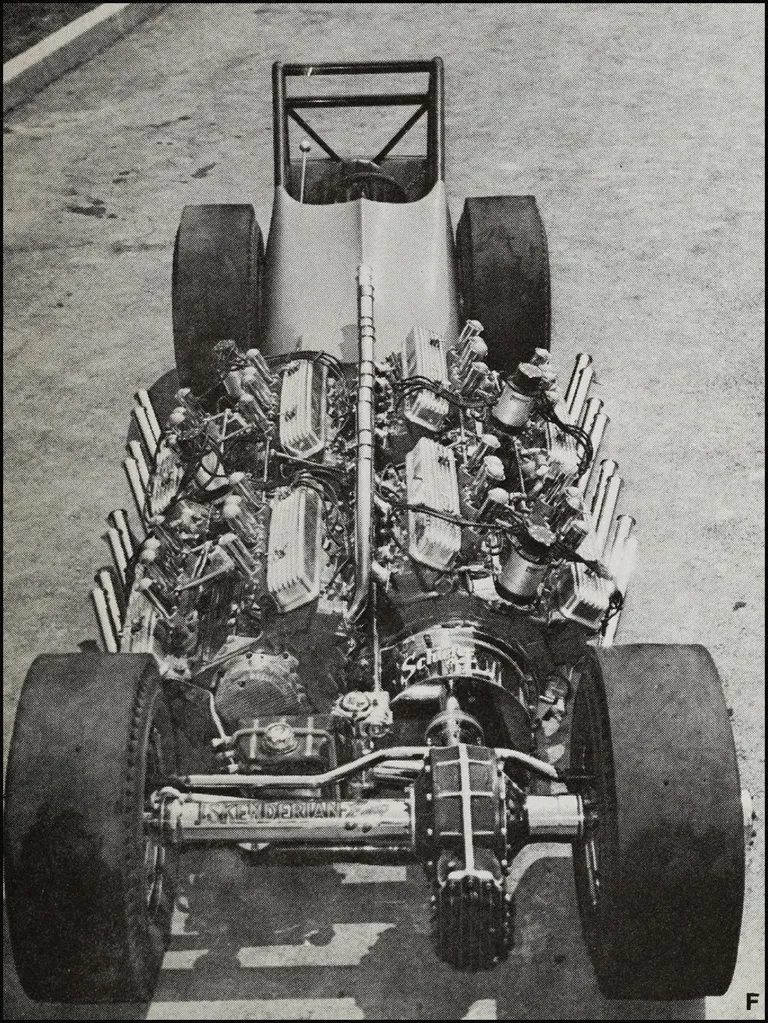
The trick was to get the best possible weight to horsepower ratio and then maximize traction by positioning that weight where it put just the right amount of downward pressure on the rear wheels. The solution wasn’t as obvious as it seemed. Too much weight on the rear axle and the car bogged down, too little and the wheels spun.
Ideal engine placement seemed to be just ahead of the rear axle with the driver up front. Many drivers felt this configuration made it harder to sense a car’s attitude under hard acceleration but were willing to tolerate the compromise for the improvement in performance. One for whom just better was not good enough was L A Times pressman Mickey Thompson, who built himself a car with the engine ahead of the rear axle, and the driver behind it.
Amidst a field of very strange machines, many thought this was the strangest of all. A friend said it looked like a slingshot with the driver as the rock, and the name stuck. At first, Thompson and his odd looking machine met with much good natured ridicule in the pits, but the mockery melted away once he got it out on the track and proved decisively that he had discovered the secret to the kind of near optimal weight distribution that won races. He was so successful with it that, within a year, his slingshot design had become the standard configuration for most “rail type” dragsters, and would remain so for nearly 20 years.
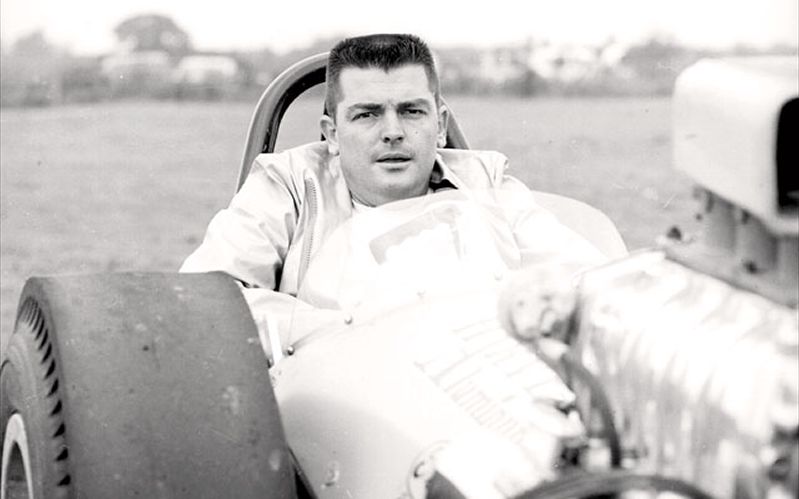
With the development of the rails, and specifically, the slingshot, drag racing was moving away from the informality of the old dual purpose, “run what you brung” contests, to a much more specialized, exclusive, and expensive format. So, in order to continue to accommodate all comers, the NHRA created a couple of dozen classes from street cars to supercharged rails divided by body and chassis type, weight, and engine size; but on the way from whatnot to slingshot, they drew the line at rocket fuel!
Nitromethane dramatically boosted performance, but it could be dangerous and was very expensive. Parks, as well as many of the drivers felt that using these fuels was cheating; faster times through chemistry rather than hard work and mechanical ingenuity did not conform to the NHRA’s view of what the sport should be about, so nitro was banned at all their sponsored events. But proprietors of un-affiliated “outlaw tracks” not only welcomed drivers willing to run the louder, faster, fire breathing nitro powered machines, but sought them out for the really big crowds they could draw, and that, more than anything else, pointed the way of drag racing’s future as a spectator sport.
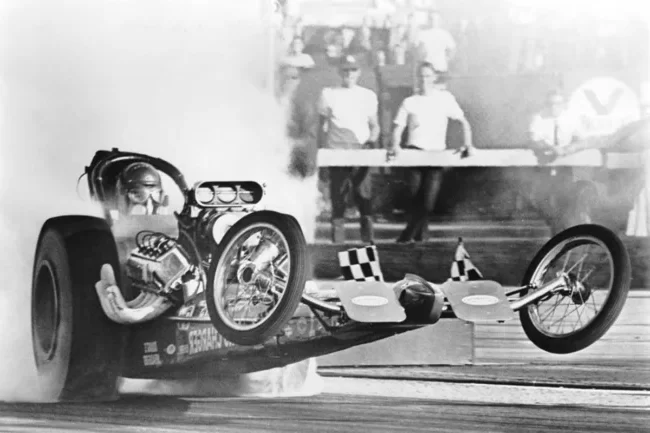
Though the NHRA and Hot Rod magazine would preserve a nitch for the weekend warriors and backyard builders, they could not stop the sport from going all-out pro. Throughout the 1950s, drag racing would attract increasingly larger crowds, corporate sponsorship, and media coverage, and by the turn of the decade, evolve from a contest between a bunch of Joes and their jalopies into a multi-million dollar entertainment enterprise.
Bonus Tracks
Here’s a short (15 minute) YouTube video taken back in the early days of drag racing