
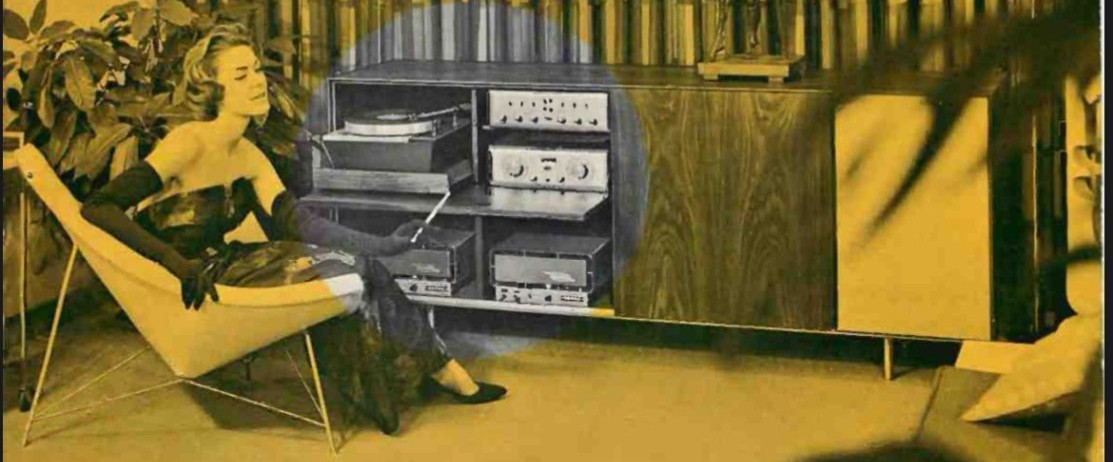
The 1950s never sounded so good
As most already know, stereo is a recording and playback technique where multiple, independent sound sources are recorded on separate left/right channels and played back on separate left/right loudspeakers in order to create the illusion of natural, directional sound.
The technology was initially developed in the early thirties, but it wasn’t until the mid-fifties that it reached the level of refinement necessary for a commercially viable consumer product. Then, in the summer of 1957, two small labels (Bel Canto and Audio Fidelity) got out ahead of the big boys by releasing the first commercially available stereo recordings, designed specifically to highlight the unique capabilities of this new entertainment medium.
Both of these “demonstration records” featured musical selections on the front side, and sound effects on the back, with Bel Canto offering a sonic tour of L.A., and Audio Fidelity taking the listener on a noisy train ride. Recording on two independent channels and using a mix-down technique known as “pan-pot stereo,” the different sounds would pass thrillingly back and forth between the right and left stereo speakers.
Gimmicky as it was, the buying public was absolutely entranced by the stereo experience and soon, all the major labels were producing their own hyper-stereophonic demo records, and establishing their own “stereo divisions” (RCA, Living Stereo and Stereo Action; Decca, Phase 4; Capital, Full Dimensional Stereo; Liberty, Visual Sound Stereo and Spectra Sonic Stereo; and Mercury, Perfect Presence Sound) to turn out more commercially oriented product specially tailored to maximize the sonic potential of the new format.
To this end, Liberty Records recalled the Martin Denny Group back into the studio to re-record their recently released, Exotica album in the company’s new Spectra Sonic Stereo process.
Re-released in 1958, Exotica, in full-range stereo, became a favorite demo record in appliance and department stores all over the country, and consequently, one of the biggest sellers in the record bin. Before the year was out, the Denny group even appeared on television’s foremost rock ‘n’ roll showcase, Dick Clark’s American Bandstand.
A few months later, the single, Quiet Village climbed to number 2 on the Billboard top 40 charts, the Exotica album hit the number 1 spot, and Martin Denny had become the world’s first “stereo star.” The other labels scrambled to find potential stereo stars in their own stables whose works could not only sell records, but also the new stereo equipment necessary to play them.
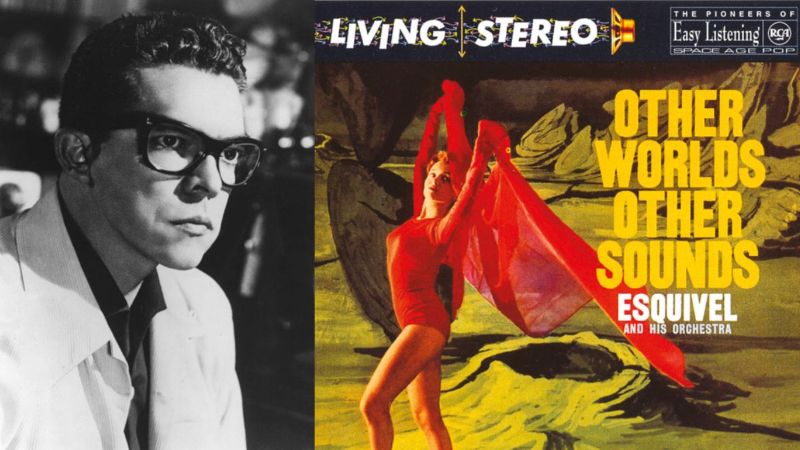
RCA had a winner in Mexican maestro Juan Garcia Esquivel, whose special brand of “space age pop music” played back in a continuous stereo orbit, with instruments, choruses, and whole orchestral sections bouncing back and forth between speakers like ping pong balls.
Most of these stereo records could be played on the old, monaural record players, but in order to experience true stereo, one had to purchase a completely new system, and they weren’t cheap. Yet, within just a few years, they were practically commonplace.
Aside from the obvious improvement in audio quality, the stereo’s rapid ascension as an essential household appliance had much to do with the appeal of these sparkling stereo recordings and how well they fit into the Southern Californian’s understanding of what the good life ought to be, and how it ought to sound.
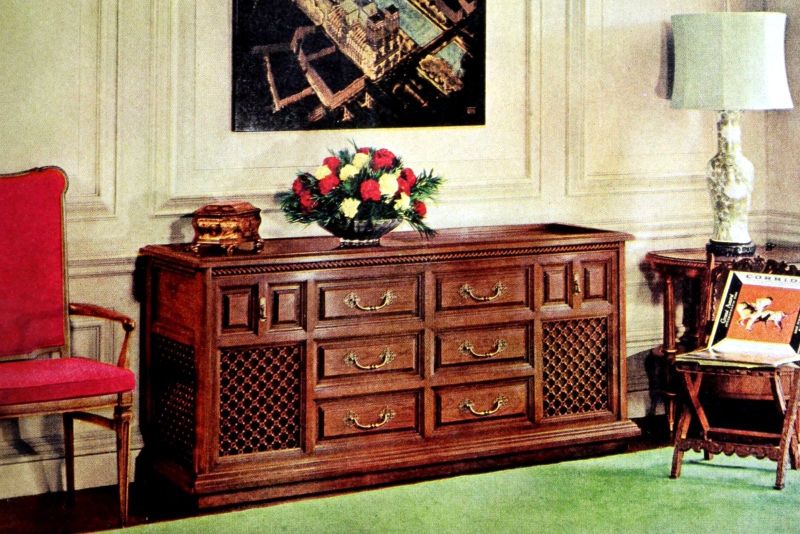
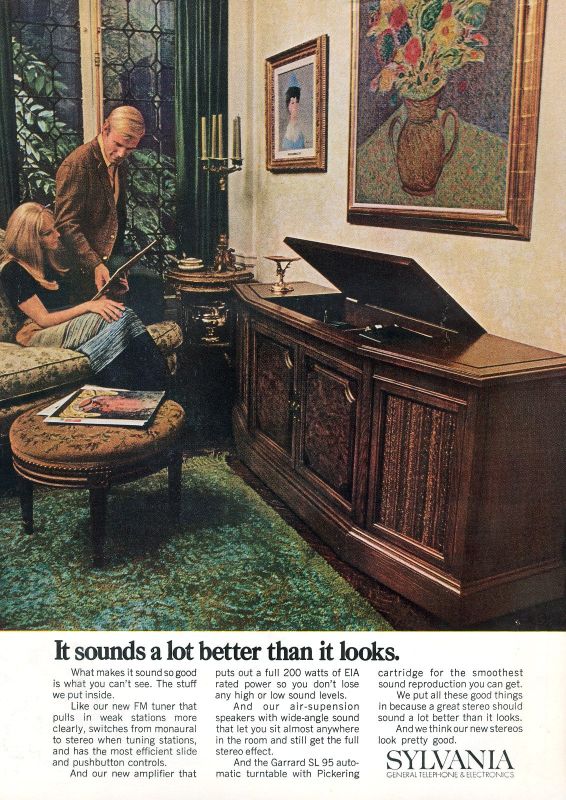
There were several configurations of stereo playback systems available to the consumer in 1958. At the lower-end, was the portable, suitcase style, record player with detachable speakers, but the most popular units were the higher-end consoles.
Usually housed in beautifully finished wood cabinetry, they were laid out horizontally for optimal speaker placement with the amplifier, radio tuner, and stereo turntable mounted in-between. These units produced exceptional sound quality; however, for those who were really and truly serious about stereo sound reproduction, modular was the only way to go.
For the true, mid-century stereo enthusiast, or “audiophile,” a top-quality stereo system had to be assembled with individual, or modular, components (amplifier, tuner, turntable, and speakers) from a variety of manufacturers who specialized in building, what were considered, the best examples on the market.
Magazines catering to the would-be audiophile quickly emerged to guide the novice on the path towards audio Nirvana with tips on the hottest, high-performance components, the top ranked tweeters, the wildest sounding woofers, how to limit wowing and fluttering, how to maximize frequency response, the proper placement of speakers, and even the proper placement of listeners. By 1959, stereomania was running rampant among Southlanders.
In many a suburban home, and nearly all swinging, Southern California bachelor pads, it was the stereo, and not the television, that served as the primary, domestic entertainment tool, running day and night spinning out a steady stream of ambient, aural wallpaper.
Relying mainly on virtuoso musicianship and technological wizardry to sell records, the major labels promised ever-greater stereophonic pyrotechnics with each new release, but it was actually a small, independent outfit that was the first to really deliver on that promise.
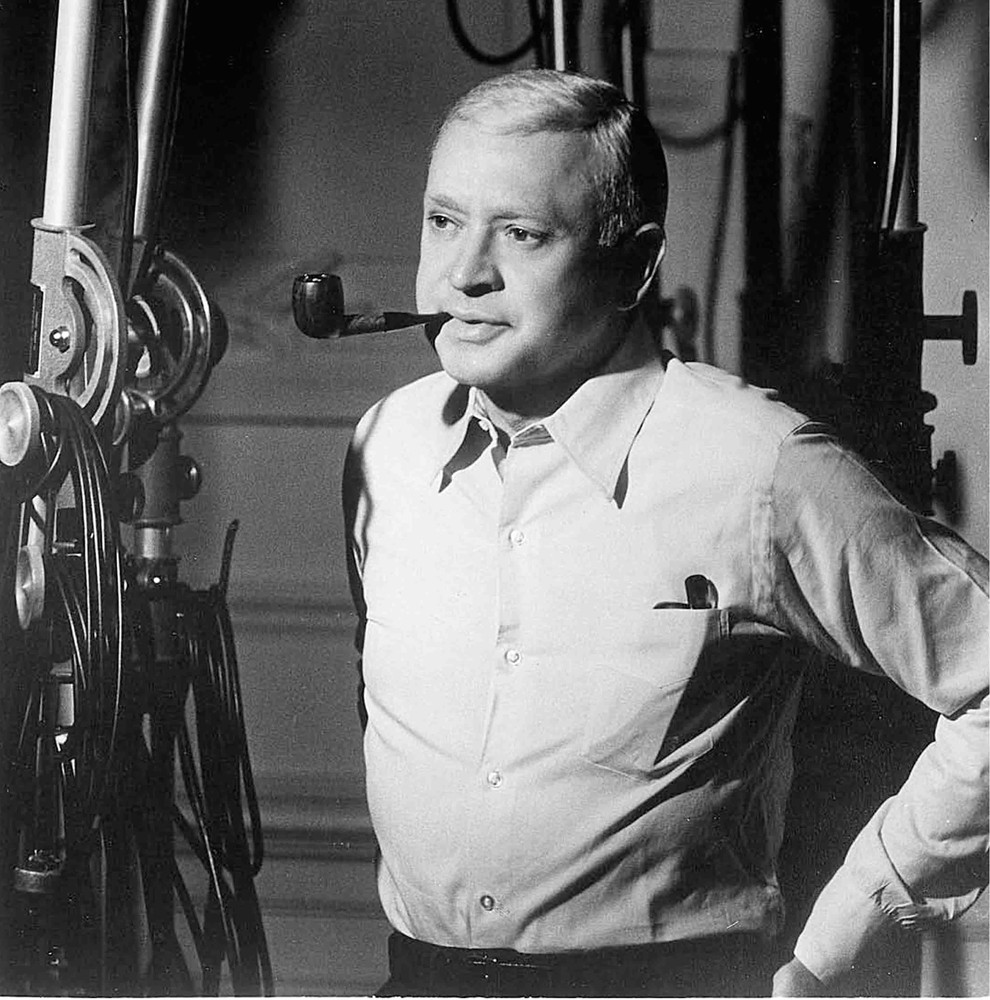
Musician, Enoch Light, founded Command Records, in 1959, intent on producing stereo recordings of superior quality. Though his records rarely received radio play, his first commercial release, Persuasive Percussion (1960), racked up huge sales mostly through suburban discount chains like Unimart, Fedco, and Whitefront.
This was true of nearly all varieties of the voguish, Southern California musical styles. Denny was an exception to the rule. Few exotica groups or jazz ensembles got much radio play. Instead, they sold records in these same suburban outlets through word of mouth and through the evocative imagery of their album covers, which were designed to convey a promise of sensual, sonic worlds yet to be discovered.
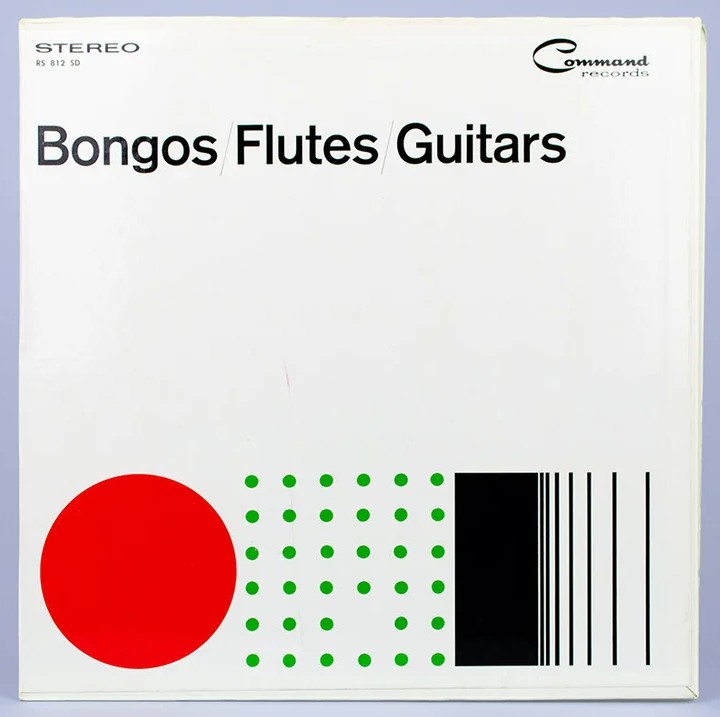
The pristine quality of the recording was so spectacular that it launched a drum fetish among audiophiles, becoming such a successful release that its formula—a jazzy ensemble completely surrounded in the stereo spectrum by a full detachment of drums, especially bongos— became a production blueprint for every label working the stereo market.
In 1960, just incorporating the word, bongos, into the title of a record like Time’s Bongo and Brass, or London’s Bongos of the South, or Command’s own Bongos, Bongos, Bongos was enough to guarantee respectable, if not better, sales figures.
At the dawn of the 60s, it was this whimsical, enigmatic exotica music and lightweight, popish, unabashedly upbeat jazz, served up through brawny, hi-fidelity, stereophonic sound systems that provided the principal soundtrack for the good life in mid-century Southern California; and there was still one more voice yet to be blended into the mix—the electrified sound of surf.
Bonus Tracks
Command’s Bongos Flutes Guitars was a mainstay on my dad’s turntable when I was a kid and on that brawny system with the big Bozaks, it really did seen as if the group was in the room with you. You won’t get that same sensation on your iphone or pc speakers here is the whole thing as archived on YouTube – Bongos Flutes Guitars