
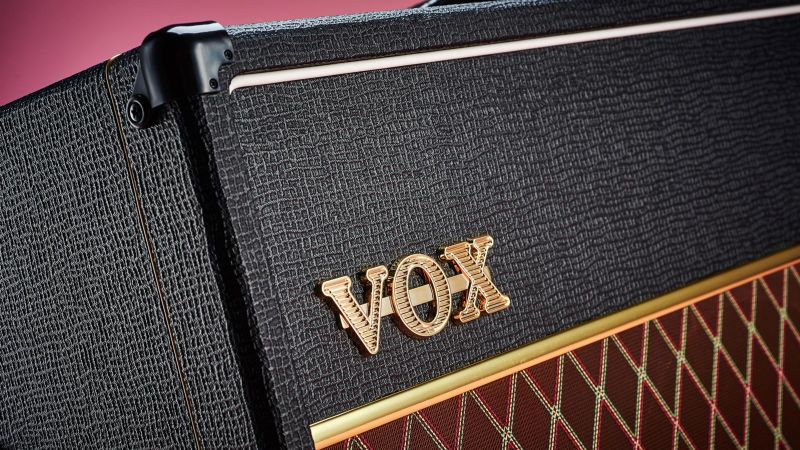
In one evening with the Beatles,Vox went from an unknown to a top contender among the biggest names in the business
Never before, or since, or probably ever again will the world experience the magnitude of the pop-cultural Tsunami that occurred on the nineth of February 1964 when the Beatles first appeared on the Ed Sullivan Show.
Before a television audience of seventy-three million Americans, and who knows how many others throughout the world, everything changed. And the ripples of that blast can still be felt today.
I had never seen or heard anything like them. It was as if I was watching rock music being reinvented right before my eyes. It was a visual and aural shock to the senses, and at the very impressionable age of twelve, I was at exactly the right moment in my evolutionary process to have my musical sensibilities completely and indelibly shaped by them and all those who would soon follow them to America.
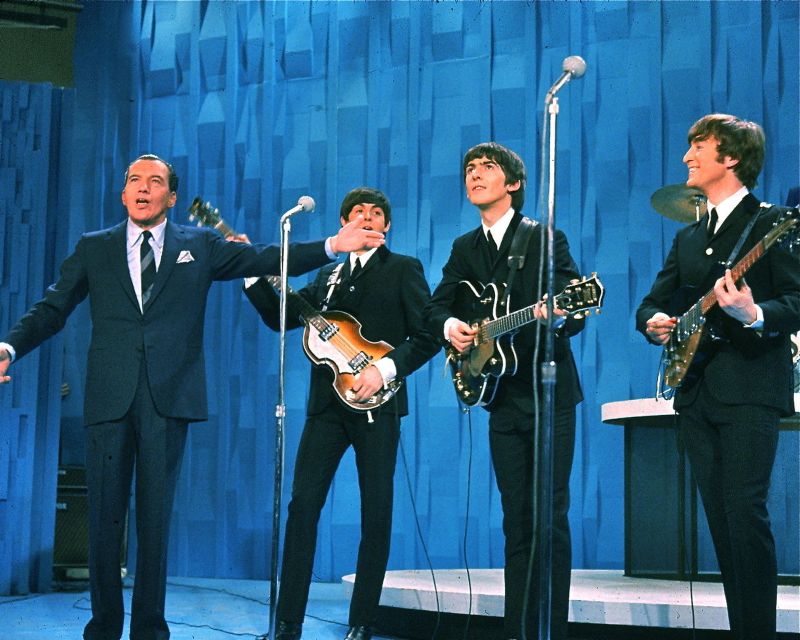
Prior to the Beatles, no British group or performer had ever penetrated the American pop charts, and within just a few days of that groundbreaking event, they owned them.
For the remainder of the 1960s, they dominated American pop culture, not only in music, but in fashion, art, film, and television, Britania ruled!
And have remained a major influence on our culture ever since. But back in 1964, they had just begun their meteoric ascension, and Americans were showing their approval with record sales that numbered in the millions.
But for a lot of young boys (and possibly a few girls), it wasn’t going to be enough for us to just appreciate the Beatles and their music, we wanted to be like them, and look like them, and make music like them, and it’s amazing for me now to recall just how hard and fast that impulse struck. Right away, music stores all over the country were besieged by kids with their parents in tow searching for their first guitar.
Of course we all wanted a guitar just like the Beatles played. I lived in San Diego, just down the interstate from Fender, so every music store in southern California was practically a Fender outlet. But our Ozzie’s Music did have a shiny new Gretsch Country Gentleman just like the one George played.
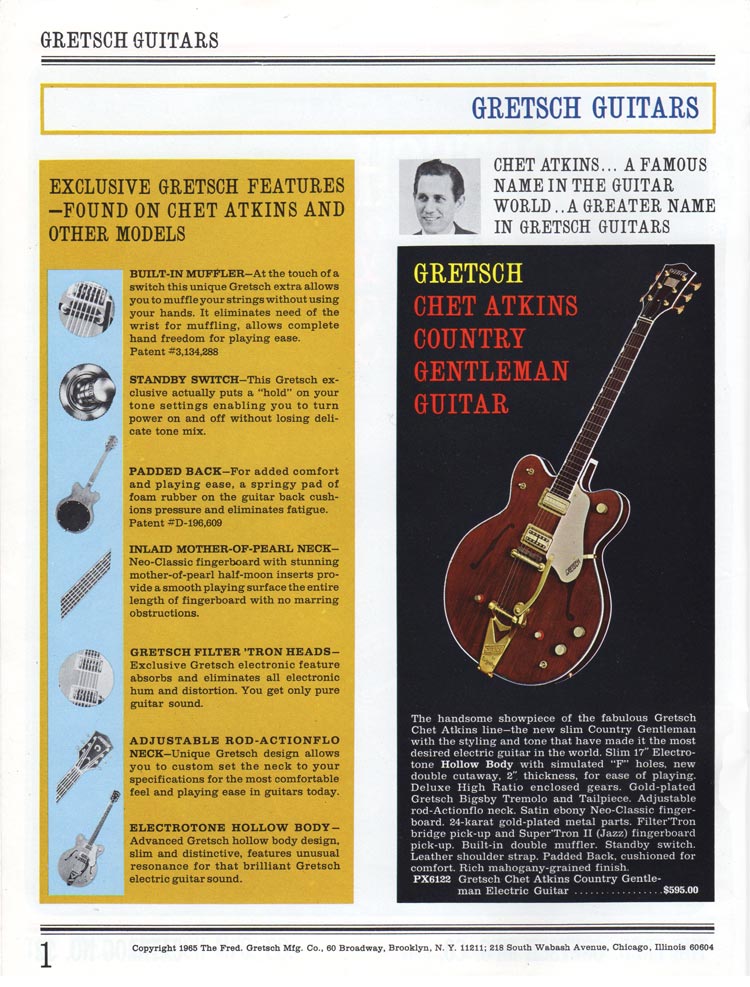
“That’s the one I said, I’d like that one.” And, for a moment, it almost seemed possible, until my parents saw the price tag swinging from the headstock – $595.00!!! That’s over six grand in today’s dollars.
So I moved on to John, “what’s he got?” As it turned out, Ozzie’s carried Rickenbacker as well. But John’s demure model 325 was still a staggering $329.50.
I had no idea that Paul’s cello-like thing was actually a bass, and once I found out what a bass was, I wasn’t interested; so we left empty handed – this time. A little while after my first visit to a music store, I bought a twelve dollar Japanese Teisco Del Rey from an older boy in my neighborhood.
It was in pretty rough shape which forced me, aided by my very capable grandfather, into committing my first act of guitar repair. And we did a pretty good job of it. We even re-finished it in white. Why such a pedestrian color you might ask – because I had recently seen the T.A.M.I. Show at the Helix Theater and got my first look at Brian Jones’ and his stunning teardrop-shaped Vox Mark III guitar – also in white.
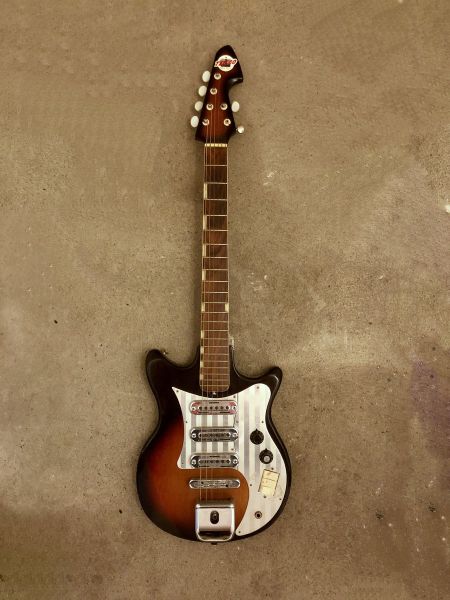
So I got a guitar and was taking lessons at Ozzie’s, but I couldn’t afford an amplifier so, I played my Teisco unplugged for some time before my dad came home from work with a big, beat to hell, plywood stereo cabinet with a 12 inch woofer and two tweeters that someone had given him.
Then he surprised me again the next day with a lunchbox sized, five watt amplifier he picked up at Radio Shack, which we put together on the kitchen table. The Vox logo on both the amp and the speaker cabinet was a freehand felt-pen creation of my own.
Oh yes, I was keenly interested in how the sausage was made, so I became aware of Vox (through other television appearances, photos in magazines, and of course, the movie, A Hard Day’s Night) at a pretty early stage in my fandom.
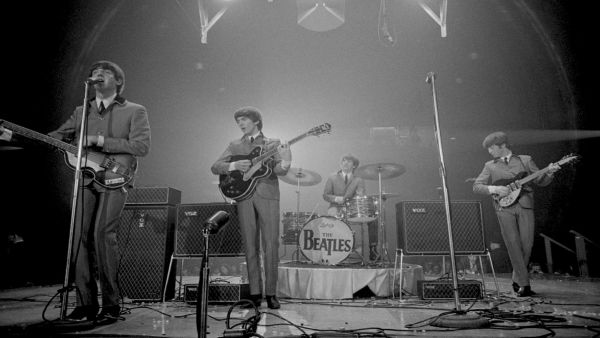
All the kids I knew who had recently taken up the guitar wanted “The British Sound,” and sound wise, the common denominator among all the those British groups was their Vox amplifiers; not that any of us could distinguish the sound of one amp from another, but there was also the looks factor one had to consider – they just looked so much cooler than all the other brands.
The Vox guitars, on the other hand, were never really as desirable as the amps. However, among this new army of teenaged Vox fans, I was an outlier, for I really liked those crazy shaped guitars as well. But it would be quite some time before I would even be able to see any of this highly coveted Vox gear up close because there wasn’t any Vox gear (or very little) available in the U.S.
Vox was made in Dartford, England by a small company called Jennings Musical Industries (J.M.I.) that had not anticipated the Beatles success in America and now, like Gretsch, Rickenbacker, Hofner, Ludwig, and any other instrument manufacturer associated with the Beatles, they were drowning in orders coming in from all over the world that they couldn’t fill. And so a deal was made with the California based Thomas Organ Company to distribute Vox products in the U.S.
But even with a robust distribution network, Vox still couldn’t turn out product fast enough to meet the demand, so Thomas Organ, not willing to miss the moment, expanded and redesigned the amplifier line as solid-state units and began manufacturing them in Sepulveda California. Any resemblance to the original JMI versions was only skin deep.
For the guitars, the yanks added several new models to the line up and hired the Italian instrument manufacturer Eko to make them. And once the warehouse was full, they began doing endorsement deals with everyone from the Beatles to the Banana Splits, putting these new Vox branded instruments in the hands of prominent players all over the country with a very special emphasis on the California groups where the film and television cameras were located.
Nearly every west coast band that appeared on the popular teen variety shows like Shindig, Hullabaloo, and Where The Action Is, as well as in countless teen oriented films like The Ghost in the Invisible Bikini and Riot on Sunset Strip, was seen playing Vox guitars and amps.
Thomas Organ even had Hollywood custom car guru George Baris build them a supercharged Vox-mobile with built-in amps, and even a Vox Continental organ, that would appear at public events where it was used to power a full band.
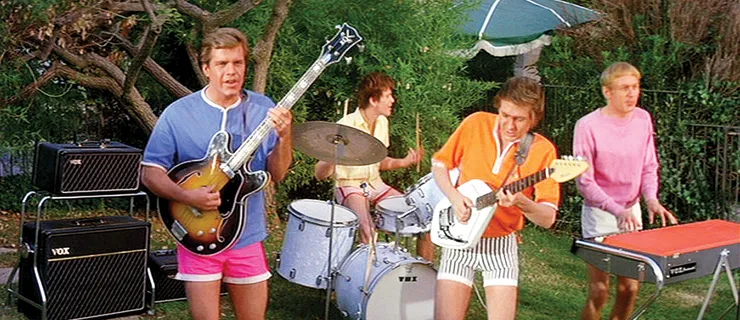
But even with this major marketing assault, it would be over a year before Vox products finally appeared in my hometown of San Diego.
My local music store never did carry Vox, possibly due to agreements made with Fender, and I didn’t know of any who did, until the spring of 1965.
It was around that time that word finally got back to me, probably though my network of novice guitarists, that there was a music store way down town that was jammed to the rafters with all manner of Vox amplifiers, guitars, and other related commodities, and I knew that somehow, I had to get down there.
Apex Music was in the 800 block of 5th avenue in downtown San Diego, or ten miles and a world away from my suburban enclave of La Mesa. I knew my parents weren’t going drive me downtown and back so I could gawk at instruments I couldn’t possibly afford, but it didn’t matter; I knew of another ride that would never deny me – the San Diego Metropolitan Transit System!
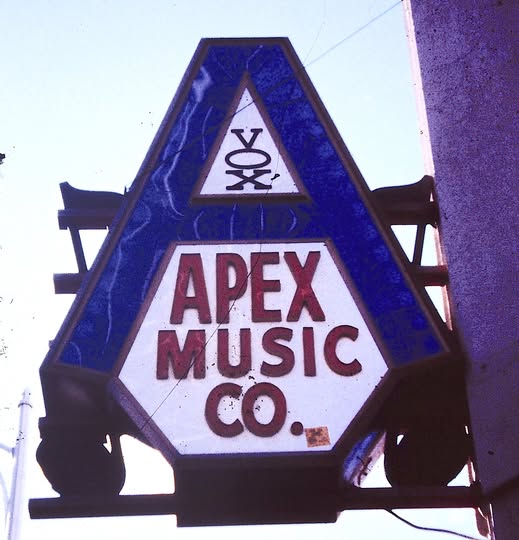
Though I had never tried it before, I was aware that, just four blocks from my home, you could hop on the number seven bus at the corner of Rolando and El Cajon boulevard and ride it all the way downtown and back for just one dollar, and that it would drop you off within a few blocks of Apex Music.
So, I gathered up a few equally adventurous friends who suffered from the same Vox infatuation as I, and we took that bus all the way to the depths of the downtown business district to see if these rumors were actually true.
On a warm, sunny, Saturday morning in 1965, we made our way to Apex Music and were not disappointed – the rumors were true, they had it all. I don’t know this for a fact, but, in hindsight, I would guess that Finder’s, the big downtown music emporium, might have had a no competition agreement with Fender and Gibson.
So little Apex Music (it couldn’t have been more than 2000 square feet) compensated by arranging to be the city’s exclusive Vox dealer, and, as I remember it, that’s about all they stocked at the time – and it was glorious.
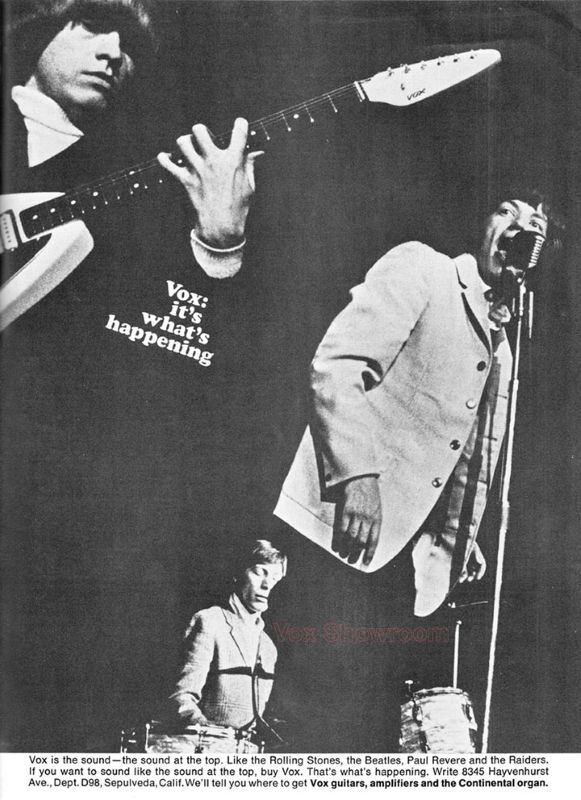
All the walls were lined with Vox amplifiers in their glistening chrome stands, and above them hung the guitars in an assortment of bold primary colors and sublime sunburst finishes, and yes, of course they had a teardrop shaped Vox Mark VI – in white no less.
It was hanging next to the “Vox: It’s What’s Happening” poster featuring Brian Jones – but they had all the other ones as well as all the silky purple and gold banners announcing their status as “authorized Vox dealers,” and other sundry sales slogans.
Unfortunately for us, the salesmen insisted on a strict, look but don’t touch, policy, which I assume only applied to grimy, penniless, thirteen year olds. But they did play them for us, so we got to see and hear them up close with all that twangy tremolo and reverb washing over us, and that alone was worth the trip.
I was so smitten with the Vox mystique that I gave them five dollars down on layaway for that Vox Mark VI guitar, which they still have, and they gave me a copy of the current Vox Teen Beat Magazine, which I still have.
For a kid so thoroughly enchanted by the Mersey Beat sound, the experience was absolutely spellbinding. We felt like we rode the bus from La Mesa to London for all the British Invasion vibe that sprang forth from that one little establishment never knowing that all the guitars were Italian imports, and the amplifiers were made right up the interstate at the Thomas Organ factory in Sepulveda, California. Not that any of those details actually mattered to us.
That sort of sonic sophistication and snobbery was still a long way off. And if I’m to be really honest, sixty years on, it still doesn’t matter. I think the guitars were very well made, had a unique sound, and played very nicely. And the solid state amps sounded very good to my ears, and for a few years, I would own them both.
I think I might have made this pilgrimage one more time before Vox equipment began turning up at the more conveniently located establishments and I eventually bought a used Vox Viscount solid-state amp, and I was never the wiser. It sounded just fine to me, and the cool factor registered a very solid 10.
But I eventually let it go, just like my red Vox Phantom VI, and my Vox Apolo guitar, and another Vox Berkeley amp, all of which I enjoyed very much but inevitably passed them on to others and now they are listed in my “who knew” column of what were once “just old instruments” and are now highly collectable and irredeemably expensive antiquities.
As for the Vox Musical Instruments Company, it would change hands many times before being acquired by its current owner, Korg of Japan in 1992. And they are still making the venerable Vox AC30 amplifiers that powered the Beatles performances back in the early 1960s. And after all these many years, Vox is still “what’s Happening.”
And I never got over my fascination with the old 60s sound, and I still have a couple of 21st century Vox amps (yes, they’re solid-state, but quite capable) and I also have a very good copy of a Vox Phantom guitar out in the garage, which I’m restoring and refinishing – in white, of course.
Bonus Tracks
If you would like to see Brian Jones wail away on his Vox Mark III guitar on the T.A.M.I. Show, here is the YouTube link to the full length version of the film.
And here is a link to a very interesting and informative website called the Vox Showroom.
Back to the Cpop Guitar Shop
The California Pop home page