
Is it the rarest of all the G&L guitars?
I picked up a guitar the Monday after the Sunday I saw the Beatles perform on the Ed Sullivan Show, only to discover that I lacked the musical talent necessary to achieve a satisfactory level of proficiency with the instrument. Never-the-less, I couldn’t put it down, and for many years after, I remained a committed strummer well-versed in the various arraignments of cowboy and barr chords.
My career as a guitarist might have ended right there on the living room couch were it not for a boredom inducing, on again-off again, work schedule that allowed me the time to inadvertently discover that, under the right circumstances, I could be a halfway decent songwriter. This revelation soon led to a four-year-long stint in an L.A. rock band that achieved nearly three of the allotted fifteen minutes of fame that was once promised to us all by that Warhol fellow.
It was during these brief few years that I realized, through regular visits to the local guitar shops on Santa Monic Blvd, that my ham-fisted guitar playing improved in direct proportion to the width of the neck of the guitar I happened to be playing at the time. Wide necks good, slim necks bad. And it seemed to me that 99% of the guitars available were of the slim-necked variety.
However, I had heard that some of G&L’s models did come with wider necks. Now, when looking for a new instrument, most people shop at a retail store, but I had met Leo Fender before, and so I felt comfortable going right to the source – the G&L guitar factory in Fullerton California.
After completing an eight-week luthiery course, in the summer of 1981 with master luthier Bozo Podunavac, I worked at the Fender factory and visited G&L’s factory and met Leo. I believe it was regarding a job there. However, the trek from mid-town L.A. to Fullerton was getting to be just too much and I soon quit Fender after about a year.
But I believed that this brief introduction was enough to at least get us in the door, so I, my wife, and our bass and lead player all made the pilgrimage to the G&L factory in March of 1986.
I really came not knowing what to expect. Did they accept visitors to the factory? Did they sell direct to the public? What I didn’t expect was to be warmly greeted by both Dale Hyatt (sales manager) and Leo Fender, and graciously shown into an informal little showroom where a couple of their latest creations were on display and available for a test drive.
Our lead player really liked the new Broadcaster and bought one on the spot. I liked it as well but to me, the neck wasn’t beefy enough to suit my needs. So I explained to our two hosts what I was really hoping to find. Leo sat back in his chair and thought for a few seconds, probably running though the entire inventory in his head, when Mr. Hyatt said, “what about that old G200?” Leo agreed and sent him off to find a G200.
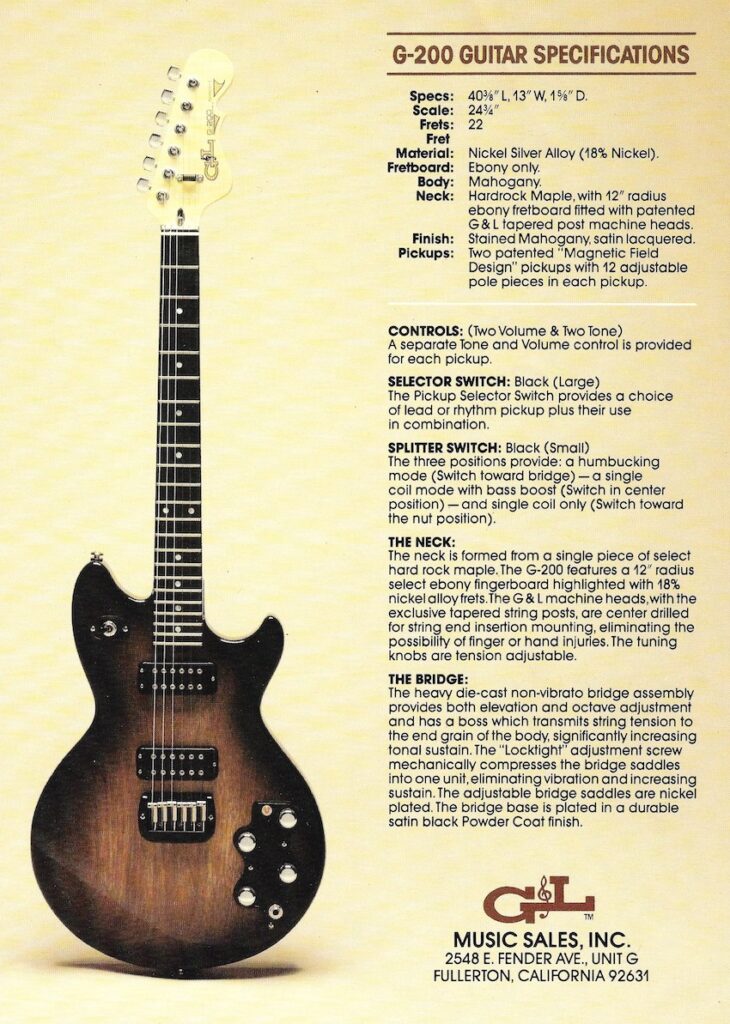
At the time, I had never heard of a G200. The strat styled F100 I was aware of, but not the G200, And no wonder. It was introduced in 1981 and discontinued in early 1982 with only 209 examples ever made. It was an attempt to incorporate some of the features of the Gibson Les Paul (the 24.75” scale length and the dual humbucking pickups) that was soundly rejected by players mainly due to its odd appearance.
In the age of the heavy-metal shredder, nobody wanted a guitar that looked like it could have come from the stereo department at Sears-Roebuck. Leo also claimed to have never liked it, and so when Dale Hyatt emerged from the factory floor, he was holding the very last G200 available from the original source.
Just exactly how rare this, “last of the G200s,” was did not become clear until I started to play and Mr. Hyatt told me of its unique history. The guitar, built five years earlier, in 1981, was a custom order for the legendary jazz guitarist Alvino Rey.

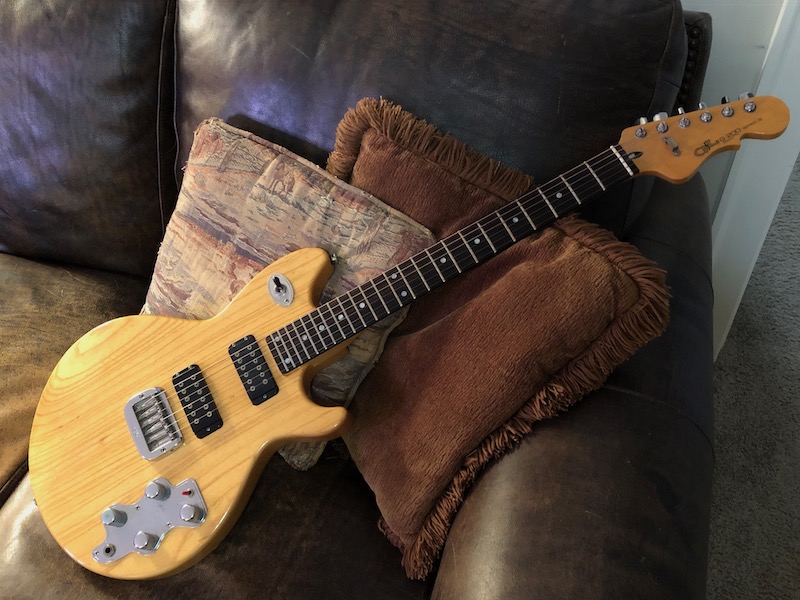
It seems Mr. Rey had very large hands and preferred guitars with more fretboard than was generally available on nearly all standard production models. And so, G&L made him two G200 guitars with the necks a whopping 48 millimeters wide at the nut, with a 7.25-inch fretboard radius, and 24 frets. The standard models had a 42mm nut width, a 12-inch radius, and 22 frets.
Mr. Rey took one of only two custom G200s made, and left the other languish a full five years at the factory until I came along and bought it. The neck really was a revelation. It didn’t make me a great player, but it did seem to make me a better player, and at that moment, that was good enough.
And as I sat there on the couch plucking away, Leo came over and sat down with me and began to demonstrate the different settings of the coil-splitter switch and the different sounds you could coax out of his specially designed MFD humbucking pickups by fiddling with the tone controls.
As much as he may have disliked this model, mainly for its Gibsonesque pretentions, he just couldn’t suppress the pride he took in the electronic components he had created for it. As we sampled the various tones he would ask my opinion, and truly seemed to be interested in what I had to say. Of course, what I had to say was that I loved it, and how could I not?
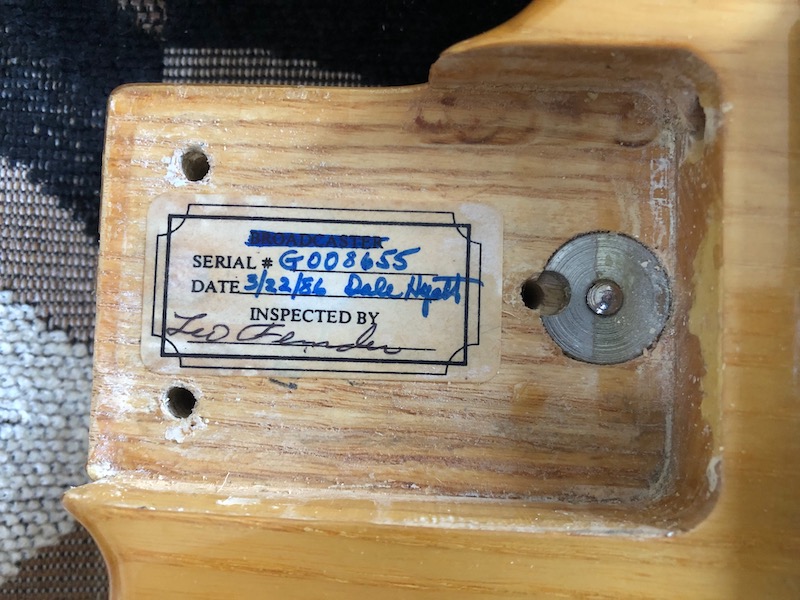
It was so exactly what I was looking for it was almost as if it had been custom made for me. After we wrote it up and before we packed it up, I had the presence of mind to ask both Leo and Dale to sign the neck pocket and they did, making it a little bit more special than it already was.
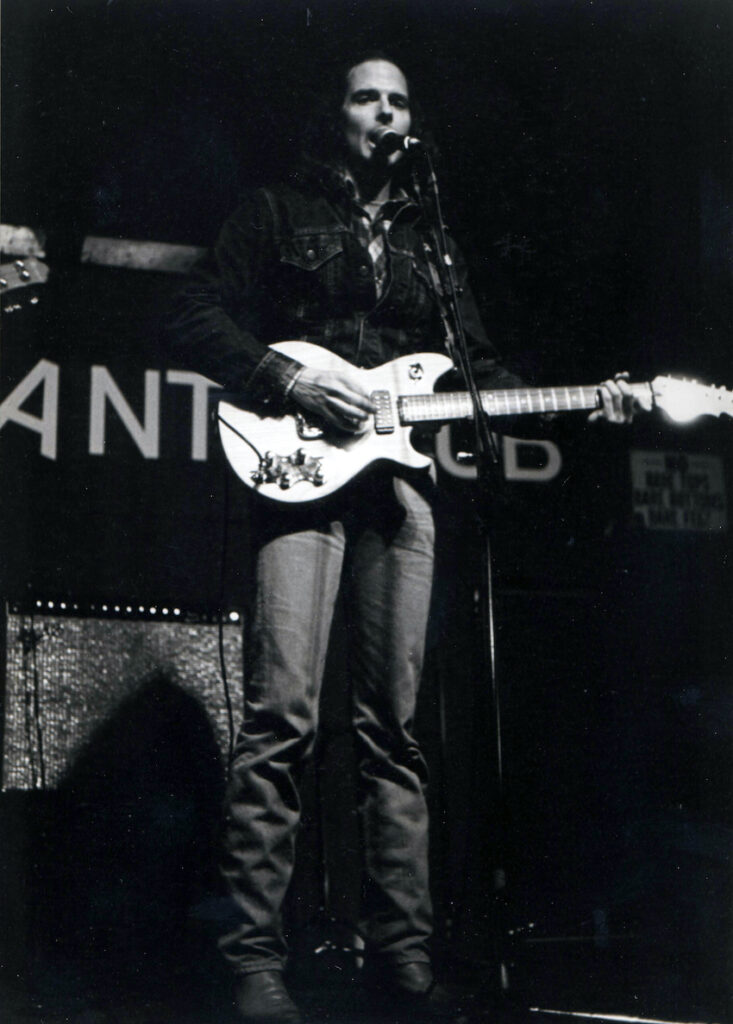
The big G200 was my main guitar for some time, but as the years passed and my dexterity improved, I gravitated away from the wide-neck towards the much slimmer handle of the Stratocaster, and then finally to the short-scaled Jagmasters and Mustangs, which are a bit kinder to my old hands.
But I still have the G200, and occasionally, I’ll pull it out to record with (Leo was right about those MFD pickups). And every time I do I’m reminded of that time I got to play a few licks and discuss lofty musical matters with the master innovator of the electric guitar.
You won’t find a G200 in the lineup today, but if you want to visit the G&L website, you will find some of the best made, and reasonably priced guitars available. G&L Guitars
Bonus Track
Way back in the 1980s, I recorded a couple of songs with guitar wizard Will Ray, who has his own signature G&L model guitar. Well, this wizard teamed up with several other wizards to form a coven of wizards known as the Hellcasters, who likewise play G&L guitars and here they are playing the hell out of those guitars on their own Hellcasters Theme.
Back to the Cpop Guitar Shop
The California Pop home Page
Post Script

Several weeks after this page was posted, I was contacted by G&L historian Gabriel Dellevigne, who shared these insights with me:
Dorian, you are the fortunate owner of a very rare, unique and special instrument from the last era of instrument manufacturing by Leo Fender. Serial number G008658 shows a completion date of September 22, 1981.
It has a hand-written note stating it was built for the late Alvino Rey and the verbiage “1st one of the new series”, the new series being the G-200 model. The PO field on the log sheet states Geo. F and Mr. F, meaning it was never produced and sold in a traditional sense as most G-200’s were. The log book provides ample provenance to your instrument and its uniqueness for certain.
The origins of your guitar start with prototypical “Gibsonesque” designs dubbed the LF-100, then the G-100 and then finally the G-200. That said, your guitar is quite a bit different from what the eventual production G-200 would become. Your guitar was a prototypical instrument for positive and predates the start of official G-200 production by two months.
The ash body with the natural finish was a specific request of Alvino and the extra wide nut width (1.875”) was also specifically developed to Alvino’s liking. The 24-fret, 24.75” scale length neck is also prototypical and did not find its way to production.
This guitar is so unique that it wouldn’t have followed the typical production process and likely was shepherded through the shop floor by Lloyd Chewning himself with guidance from George. The bridge was likely pulled out by Lloyd himself, ignoring the usual parts pulling and logging processes.
I had discussed your guitar with Dale many years ago and I knew of its existence and who it was made for. He explained he “knew it was out there” because he had sold it to a local musician who had stopped by the factory. I always wondered if it would surface but am now happy it has and that it is in good hands.
Alvino was a close friend of Leo, Dale and George going back many decades and in the early days of G&L he was given instruments to test out as he lived in SoCal at that time, prior to his relocation to Utah. Alvino was the genesis of the extra wide nut width dating back to the early Fender days when they would make special necks especially for him.
Most pre-BBE G&L prototypes are either soft maple (in sanding sealer most of the time but sometimes have a production quality finish on them) or Honduran Mahogany when it comes to this model. In addition to this, the chrome hardware is a rarity…the production guitars primarily had the semi-gloss black electrostatically applied paint.
There are some production G-200’s with chrome hardware though…just a few. The label in the neck pocket is a repurposed Broadcaster label…Dale crossed out the “Broadcaster” printing and signed it with a blue Sharpie adding a serial number too…I nice touch for certain, though Dale did get one digit wrong when he wrote this in the neck pocket, he wrote G008655 but the stamped serial number on the bridge is G008658 😊.
You have confirmed to me that the fingerboard radius is 7.5” (One of the two radii options in 1981). Remember, the fingerboard radius was sanded into the fingerboard on a swingarm fixture hanging over a belt sander. Two options at that time were 7.5” and 12”…not 7.25” as used at Fender prior to CLF Research production.
Dale and Lloyd confirmed to me that they definitely made some 1.875” nut width necks for Alvino, however, it proved too wide for the rest of the test player population, and this is how they eventually settled on the 1.75” nut width used on their #3, #4 and #5 wide neck options that showed up first in 1984. The genesis of the wide nut for certain starts with this guitar.
It is also important to note that there were both 24-fret and 22-fret variations of the G-200 prototypes existed. Alvino had requested the 24-fret version, however, the bulk of the test players preferred the voicing of the neck pickup in the 22-fret version…it simply sounded more Gibson-Like being in the same position of a 22-fret Gibson product. Dale explained that he was not going to offer two versions of an instrument that was so similar and they settled on the 22-fret version to go to market.
No matter how you slice it, you’ve got yourself a unicorn of a pre-BBE G&L that few people knew existed or perhaps even cared. Besides being a great playing/sounding guitar with a really interesting provenance, it is for positive prototypical, which always adds a layer of coolness and mystique to the instrument.
Best Regards,
Gabriel Dellevigne